This is a sequel to my previous post Notes on Psychological Landscape Part I.
In their paper “Utilizing Complexity To Change Psychological Landscapes,” Maryann Reese, MA and Dr. Miriam R. Tausner use the landscape metaphor to show the features of psychological landscape:
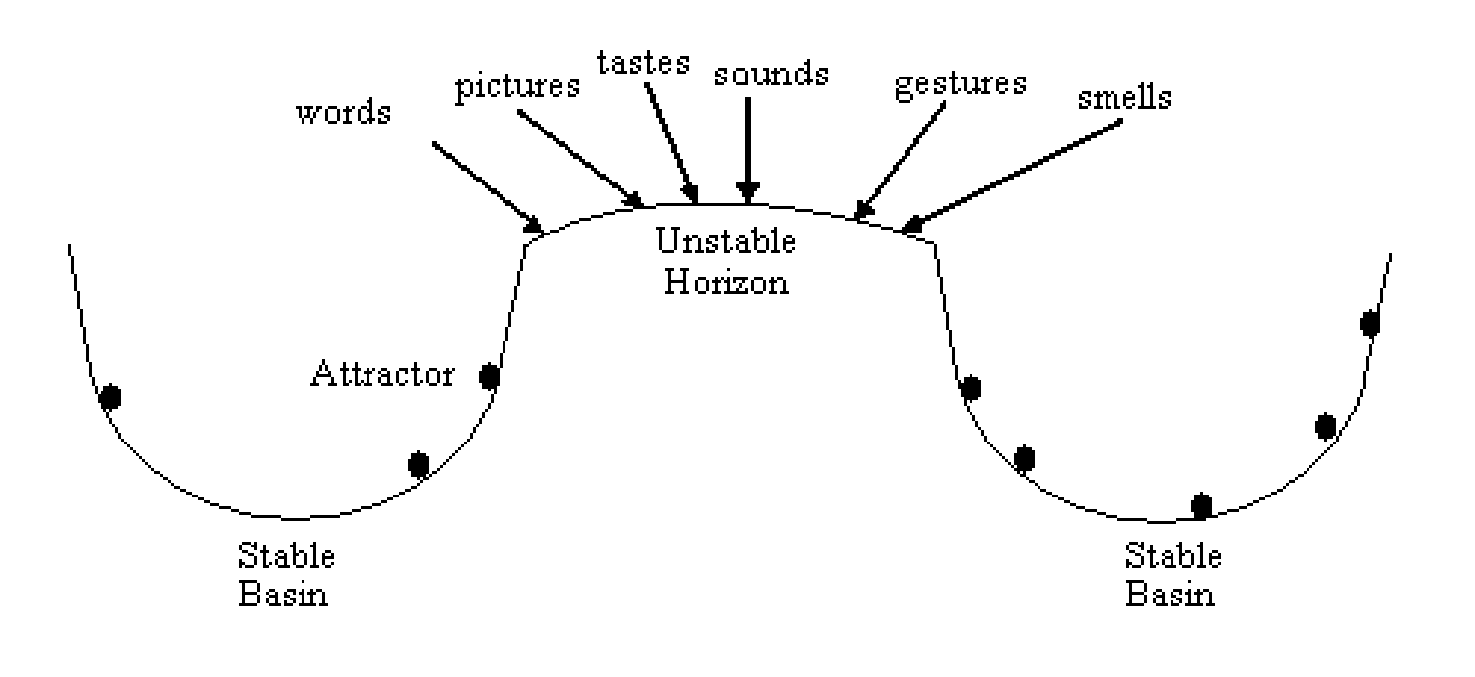
Figure I. Psychological Landscape
Psychological landscapes consist of horizons and basins of attraction. Figure I depicts a curved line with a high peak, which is the horizon, and two hollowed out tunnels, which are the basins. Horizon is a vista from which we observe our life and its surroundings. Our outlook or angle of vision is skewed by our past experiences featured here as the deep burrows or our emotional life under the surface. A wide variety of events and sensory details make person access reference points. A reference point is a marker of an event, which is a gateway to external triggers such as (see Figure I) words, pictures, tastes, sounds, gestures, smells, etc. that propel a person to an attractor in a basin. Attractors are internal representations of original experiences; in other words the attractors pull us towards positive or negative place, depending of the nature of the original experience. Figure II illustrates this process:
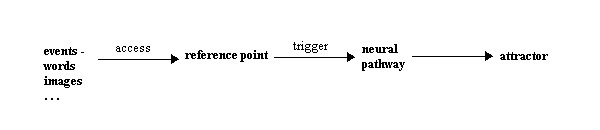
Figure II. What is the process?
How this relates to the soldier’s photograph and the war landscape framed in the bombed-out castle wall, and my psychological landscape?
Image (castle’s ruins, soldier) → access brain’s limbic system/the core of emotions and memory → trigger memories of war destruction and exile → evoke emotions → nostalgia, displacement.
The image of the soldier and castle’s ruins sends signals to the brain’s limbic system, which is the core of emotions and memory. The signal accesses the reference point in my past experience of war destruction and exile and creates a sensation of pain. Thus, the photograph evokes emotions of nostalgia and displacement.
This is my mother in her kitchen in Sarajevo, just before the war broke out in 1992, following up the breakup of Yugoslavia:

This is my mother in her kitchen in Sarajevo, just before the war broke out in 1992, following up the breakup of Yugoslavia:
And this is my mother's kitchen after the war:

Psychological landscape is the invisible landscape of our mind, a panorama of our past, present and future way of thinking, feelings and behavior. We could say that the psychological landscape of the character is the character’s vision of life. In her comments on William Styron’s short story "The McCabes," Katherine Ann Porter writes:
"Human life itself maybe be almost pure chaos, but the work of the artist – the only thing he’s good for – is to take these handfuls of confusion and disparate things, things that seem to be irreconcilable, and put them together in a frame to give them some kind of shape and meaning. Even if it’s only his view of meaning. That’s what he’s for – to give his view of life."
I thought that perhaps I could use Reese & Tausner schema of psychological landscape as my framework in writing about psychological landscape in fiction, because writers use the same reference points and sensory cues in their work to bring characters to life. Similarly, the readers experience the text through senses in order to enter the emotional life of characters. Furthermore they draw upon memories of their own prior emotions to match the emotions of the characters. Reading too, is an emotional journey. It is not my intent to trivialize the work of psychology; my objective is to illustrate ways in which writers depict “what’s going on in characters’ heads,” the cause and effect between characters’ perceptions, emotions and behavior. By using the metaphors of landscape I intend to visualize internal and external manifestations of character’s landscape of the mind.
It seems to me that writer and reader are like two travelers. They are together undertaking a journey (that’s the story). The writer creates the character, charts the psychological landscape and setting of the story. The reader follows the map, reads the signs and symbols and learns how to experience the invisible landscape of the hero’s inner reality, or in other words to feel empathy. On the both journeys, the writer’s and the reader’s experience is based on their emotional landscape, their perception of the world, because we all identify the feelings and actions of others out of our own experiences.
Cynthia Ozicks writes in her essay “The Shock of Teapots” about the sharpened sensitivity of the travelers:
"What we remember from childhood we remember forever – permanent ghosts, stamped, imprinted, eternally seen. Travelers regain this ghost-seizing brightness, eeriness, firstness. They regain it because they have cut themselves loose from their own society, from every society; they are, for a while, floating vagabonds, like astronauts out for a space walk on a long free line. They are subject to preternatural exhilarations, absurd horizons, unexpected forms and transmutations: the matter-of-fact (a battered old stoop, say, or the shape of a door) appears beautiful; or a stone that at home would not merit the blink of your eye here arrests you with its absolute particularity – just because it is what your hand already intimately knows. You think: a stone, a stone! They have stones here too!…For the vagabond-voyeur (and for travelers voyeurism is irresistible), nothing is not for notice, nothing is banal, nothing is ordinary: not a rock, not the shoulder of a passerby, not a teapot."
The act of reading or experiencing is as important as the act of writing. When I compare the writers and readers to travelers, I am assuming that they possess childlike curiosity and imagination and willingness to play and roam free, even to get lost. In his book "Maps of the Imagination: The Writer as Cartographer," Peter Turchi compares writer to an explorer and artistic creation to a voyage into the unknown. I mentioned the word empathy earlier because it is an important aspect in both acts: writing and reading. Empathy is understanding and compassion towards other human beings; it means being able to identify with another’s person feelings. An Other is that voyage into the unknown.
When we embark on that trip into unknown we construct new worlds from our reading material; we envision the places and characters we read about or visually construct the new landscapes in our imagination; we see them with our mind’s eye. We inhabit the psychological landscapes of the characters and look out at the world through each character’s eyes. How do they feel about life?
Notes on Psychological Landscape Part III will focus on writers’ techniques of externalizing characters’ intangible feelings. How do we express characters’ emotional life using other methods than first-person point of view or going directly into characters’ thoughts?
Notes on Psychological Landscape Part III will focus on writers’ techniques of externalizing characters’ intangible feelings. How do we express characters’ emotional life using other methods than first-person point of view or going directly into characters’ thoughts?


