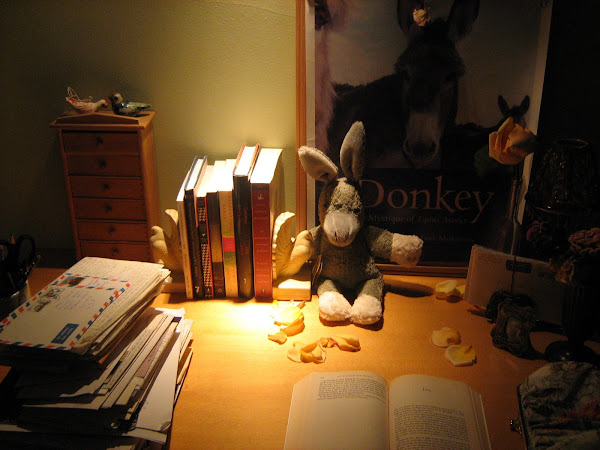
I was recently tagged on facebook with a "What kind of Book Geek Are You?" list. Although I rarely do the things it appears one is supposed to do on facebook (determine what TV mom I am? give a friend a plant?), I’d been spending days on the same scene in my new novel without too many words actually attaching themselves to the story, and so … procrastination without calories! I thought a slightly shortened version might make a decent introduction of myself as a reader, and who I am as a reader says a lot about the writer in me, too—or the writer I aspire to be, anyway. And what are we, if not our aspirations? That is (I hope) what my latest novel, The Wednesday Sisters, is about. The novel, about readers, writers, and friends, comes out in paperback tomorrow!
I’ll post more later in the week about how I write and how I got published, but for today, without further ado, here’s the Inner Book Geek in me:
What author do you own the most books by?
I have six books by each of Jane Austen, Alice McDermott, Sue Miller, Ian McEwan, and Ann Tyler. I have ten novels by Tolstoy, but eight are in a single volume. Does that count as ten or three?
What book do you own the most copies of?
Aside from my own (I just got 36 copies of the paperback of The Wednesday Sisters from Random House), I have three copies each of The Mercy Seller and The Illuminator by Brenda Rickman Vantrease. She's my best writer-pal; we started critiquing each other's work long before either of us had published anything more than her one travel article, and we now together count six books published or about to be. I drew heavily on our experience together in a writing group for the writing group the Wednesday Sisters form.
Did it bother you that both those questions ended with prepositions?
They did? I’m actually an ardent admirer of the rules of grammar, but my copyeditor at Random House assures me that the modern novelist needs to be comfortable bending them sometimes.
What fictional character are you secretly in love with?
I do like Will Lasislaw from Middlemarch and Ray from Graham Swift's Last Orders, but my true literary loves are all spunky women: Meg from A Wrinkle in Time, and Scout from To Kill a Mockingbird, Dorothea Brooke from Middlemarch, and Elizabeth Bennett from Pride and Prejudice.
What book have you read the most times?
Middlemarch or Pride and Prejudice.
What is the worst book you've read in the past year?
Since I know how very hard it is to write any book, I'm simply unwilling to trash someone's hard work on a public forum.
What is the best book you've read in the past year?
For the first time? Peter Ho Davies' The Welsh Girl and Michelle Richmond's No One You Know. I've read some great nonfiction, too, including The House of Mondavi and Towers of Gold.
What book would you most like to see made into a movie?
The Wednesday Sisters. (Not for the obvious financial reasons, although I'd spend it wisely, but because movies sell books!)
What is the most obscure Shakespeare play you've seen?
Are any Shakespeare plays obscure? Obscure, from my dictionary: "relatively unknown." Where do I sign up for Shakespeare-level obscurity?
Do you prefer the French or the Russians?
Russians.
Roth or Updike?
Roth.
Sedaris or Eggers?
Sedaris.
Austen or Eliot?
Both! I love Middlemarch better than any single Austen, but I like all of Austen put together better than all of Eliot.
What is your favorite novel?
Toss up between Middlemarch and To Kill a Mockingbird.
Play?
Les Miserables. Although I loved Avenue Q, too, and Wendy Wasserstein.
Poem?
The poem I return to most often is Elizabeth Bishop's “The Moose.” My favorite passage from it, ending with my favorite lines in the poem:
A moose has come out of
the impenetrable wood
and stands there, looms, rather,
in the middle of the road.
It approaches; it sniffs at
the bus's hot hood.
Towering, antlerless,
high as a church,
homely as a house
(or, safe as houses)…
Taking her time,
she looks the bus over,
grand, otherworldly.
Why, why do we feel
(we all feel) this sweet
sensation of joy?
The poem evokes the "sweet sensation of joy" I felt the first time I saw a moose, which was just like in this poem, through the window of a bus late at night when I was a teenager going to canoe in the Quetico. One of the characters in the novel I’m working on now, "The Ms Bradwells," uses it to describe one of her friends.
Essay?
Tim O'Brien's “The Vietnam in Me.” I carry a copy of it in my journal, which I take everywhere. Whenever I lose my courage as I'm writing (and I do), I take it out and reread it.
And... what are you reading right now?
The answer I gave for this one on facebook was Dead of the House by Hannah Green (for Molly's Kepler's Fiction Group), and Kate Brady's The Mechanics of Falling. I've since finished the Hannah Green (great discussion!) and moved on to Amanda Eyre Ward's Love Stories in this Town. I read about 75 books a year, and I keep a list of recent reads on my website. - Meg
I’ll post more later in the week about how I write and how I got published, but for today, without further ado, here’s the Inner Book Geek in me:
What author do you own the most books by?
I have six books by each of Jane Austen, Alice McDermott, Sue Miller, Ian McEwan, and Ann Tyler. I have ten novels by Tolstoy, but eight are in a single volume. Does that count as ten or three?
What book do you own the most copies of?
Aside from my own (I just got 36 copies of the paperback of The Wednesday Sisters from Random House), I have three copies each of The Mercy Seller and The Illuminator by Brenda Rickman Vantrease. She's my best writer-pal; we started critiquing each other's work long before either of us had published anything more than her one travel article, and we now together count six books published or about to be. I drew heavily on our experience together in a writing group for the writing group the Wednesday Sisters form.
Did it bother you that both those questions ended with prepositions?
They did? I’m actually an ardent admirer of the rules of grammar, but my copyeditor at Random House assures me that the modern novelist needs to be comfortable bending them sometimes.
What fictional character are you secretly in love with?
I do like Will Lasislaw from Middlemarch and Ray from Graham Swift's Last Orders, but my true literary loves are all spunky women: Meg from A Wrinkle in Time, and Scout from To Kill a Mockingbird, Dorothea Brooke from Middlemarch, and Elizabeth Bennett from Pride and Prejudice.
What book have you read the most times?
Middlemarch or Pride and Prejudice.
What is the worst book you've read in the past year?
Since I know how very hard it is to write any book, I'm simply unwilling to trash someone's hard work on a public forum.
What is the best book you've read in the past year?
For the first time? Peter Ho Davies' The Welsh Girl and Michelle Richmond's No One You Know. I've read some great nonfiction, too, including The House of Mondavi and Towers of Gold.
What book would you most like to see made into a movie?
The Wednesday Sisters. (Not for the obvious financial reasons, although I'd spend it wisely, but because movies sell books!)
What is the most obscure Shakespeare play you've seen?
Are any Shakespeare plays obscure? Obscure, from my dictionary: "relatively unknown." Where do I sign up for Shakespeare-level obscurity?
Do you prefer the French or the Russians?
Russians.
Roth or Updike?
Roth.
Sedaris or Eggers?
Sedaris.
Austen or Eliot?
Both! I love Middlemarch better than any single Austen, but I like all of Austen put together better than all of Eliot.
What is your favorite novel?
Toss up between Middlemarch and To Kill a Mockingbird.
Play?
Les Miserables. Although I loved Avenue Q, too, and Wendy Wasserstein.
Poem?
The poem I return to most often is Elizabeth Bishop's “The Moose.” My favorite passage from it, ending with my favorite lines in the poem:
A moose has come out of
the impenetrable wood
and stands there, looms, rather,
in the middle of the road.
It approaches; it sniffs at
the bus's hot hood.
Towering, antlerless,
high as a church,
homely as a house
(or, safe as houses)…
Taking her time,
she looks the bus over,
grand, otherworldly.
Why, why do we feel
(we all feel) this sweet
sensation of joy?
The poem evokes the "sweet sensation of joy" I felt the first time I saw a moose, which was just like in this poem, through the window of a bus late at night when I was a teenager going to canoe in the Quetico. One of the characters in the novel I’m working on now, "The Ms Bradwells," uses it to describe one of her friends.
Essay?
Tim O'Brien's “The Vietnam in Me.” I carry a copy of it in my journal, which I take everywhere. Whenever I lose my courage as I'm writing (and I do), I take it out and reread it.
And... what are you reading right now?
The answer I gave for this one on facebook was Dead of the House by Hannah Green (for Molly's Kepler's Fiction Group), and Kate Brady's The Mechanics of Falling. I've since finished the Hannah Green (great discussion!) and moved on to Amanda Eyre Ward's Love Stories in this Town. I read about 75 books a year, and I keep a list of recent reads on my website. - Meg


