Friday, March 27, 2009

Molly McCall: How to Pick a Fantastic Book Group Book, Or How I Attempt to, Anyway


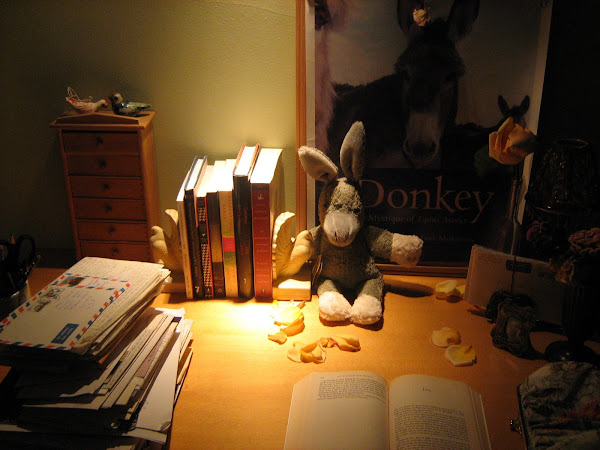
Here's a view of some of our bookcases at home. These cases are mostly fiction, alphabetized admirably by my husband, the playwright Jon Brooks, but if you look closely, you'll see nonfiction titles hanging out horizontally and stacked up above. We have cases and piles of books all over our flat, including art books, cookbooks, poetry, and children's books. Was it Jorge Luis Borges who said, “I can not sleep in a room without books?” I feel most comfortable in spaces that are crowded with books.

Aggie posted a comment yesterday asking me how I pick titles for the fiction book group. That's a great question. People ask me this from time to time, and my response always comes out differently.

I'm always looking for something unique and unexpected, something that will engender a vibrant discussion and balance well with the other novels we've just read.

I look to award-winning books like “The Brief Wondrous Life of Oscar Wao,” which won the Pulitzer Prize for fiction. I like to go back through old lists and find runners-up from days gone by. Last year, I spent some time lingering over National Book Award nominees from the '70s and '80s.

I also troll through reading lists from book stores or critics or newspapers. I'm especially interested, always, in The New York Times' picks for the best books of the year. I pay attention to reviews. I listen to book sellers and watch what the independent bookstores have on display – Kepler's especially, of course.

As anyone who comes to the group will tell you, we read current titles but we also spend a fair amount of time on books that are neglected or forgotten or come from real “writers' writers.” The people who come to the Kepler's Fiction Group are such amazing readers. So although I like to pick the latest Booker winner from time to time, I also know that they will find that book on their own.

Other aspects that are never far from my mind: how many male versus female voices we're reading, where the authors are from, what style they write in, what time period the books comes from, where the novel takes place, and what it's about. Plus, the book has to be available in paperback, accessible to Kepler's to get, and not too long (unless it's the January pick, which I push a little, because we don't meet in December).

Over the past 10 years, we've read a lot of fantastic books in the fiction group. Some day, I'd like to put together a really comprehensive list. Until that time comes, here's a brief gathering of titles I've always remembered as great discussion-starters.

  • “The Things They Carried” by Tim O'Brien – one of my all-time favorite novels and book group books. The inventive style and complicated emotions and themes offer so much to chew on.

  • “Spartina” by John Casey – Casey has too quickly become an overlooked novelist. This tale of Rhode Island fishermen won the National Book Award in 1989 and has since drifted off the literary radar. It's gorgeously written.

  • “The Road” by Cormac McCarthy – hardly a forgotten book, I'm happy to say. This post-apocalyptic tale won the Pulitzer Prize and an appearance on Oprah, hah! It's a novel that stays with you for a long time, and sparks an intense conversation about humanity, our treatment of the environment, and the future.

  • “The God of Small Things” by Arundhati Roy – we read this Booker-winner in the group years and years ago. I almost want to select it again, just to see how it's aged with us. Roy's only novel, it's a slender, masterfully done work.

  • “The Man Who Loved Children” -- by Christina Stead. A lot of people hate this book, but you're guaranteed a great group, I think. It's a feral, tough, uncompromising novel. But it's worth it.

  • “Desperate Characters” by Paula Fox -- a chilling, urbane novel. Fox writes with absolute surety. I recommend this one highly.

Oh man, there are so many more. If you are in a book group – or if you come to any of the groups that meet at Kepler's – I'd love to hear what books you love!

Thursday, March 26, 2009

KEPLER'S WRITING GROUP MEETING THIS SATURDAY, MARCH 28, 2009


Dear Writers,

Kepler's Writing Group March meeting will take place on Saturday, March 28, 2009 from 3:00-5:30 p.m. at our beautiful, new location, one block from Kepler's. Please email me at aggie@keplers.com to confirm your attendance and I'll give you the address and directions.

The following writers’ manuscripts are up for the discussion in March: Jeanne Althouse, Mary Jean Place and Mary Stahl.

SPECIAL NOTE: Well-Read Donkey is featuring profiles of Kepler's Writing Group members. Check out Bobbie Riedel's profile posted in March and check back for Megan Kurashige's upcoming profile in April! Don't forget to subscribe to get regular updates.

Wednesday, March 25, 2009

Molly McCall: One Book Group and One Brief Wondrous Novel

Many people agreed that the writing was masterful. Kristen said she wished she could write like this. Marian called the prose “amazing.” Rachel likened the style to jazz; Doug countered that it’s more like Hip-Hop.

But not everyone was cajoled by the author’s musicality. The constant drumbeat of Spanglish slowed Abby down. Susan didn’t find it lyrical at all. And it failed to delight Bobbie.

It was Monday night and the Kepler’s Fiction Book Group had gathered to discuss “The Brief Wondrous Life of Oscar Wao” by Junot Diaz. There were 11 of us in attendance. (Warning: Spoilers abound!)

I gave a little background on the author and the novel. Then, we started around the circle. Each person said what he or she thought of the book and, if they were feeling so inclined, rated the book on a scale of 1 to 5, 1 being the worst-ever grade and 5 the highest honor.

By the time we get to the end of the circle, discussion had already broken out a few times. One 5 had been dished out, two 4.5’s had flirted with the high grade, and a string of 4’s made me nervous that everyone just liked it and the conversation wouldn’t have a spark. Ha! My needless worries.

We spent some time talking about the way Diaz riddled the work with Dominican slang and Sci-Fi references. Did it put you off? Did you let it wash over you? We figured only a small handful of people in this world could get the language and the genre stuff -- so why did he do it? One theory is that it shoves the reader into this semi-alienated space -- a place well-known to Oscar Wao. It’s certainly wildly inventive.

And what about those footnotes? Doug hated them. He found them excessive and felt they could have been worked into the novel if they needed to be there. Other people disagreed and for a moment we were off talking about the footnotes’ content (Trujillo, dictatorships, the terror of life in a place like that) and their influence (David Foster Wallace, bless him, came to mind). Kristen made the point that the footnotes were a kind of working out of the “fatherlessness” in Oscar’s family and in the Dominican Republic.

Unsurprisingly, Oscar himself absorbed a lot of our attention. Some people found him utterly unsympathetic. Marian thought he was “shadowy” and inaccessible. His death, she said, was pointless. Susan was also worn down by Oscar’s victimization. Nick, though, found it disconcerting how little of Oscar was in the tale. He wanted more. Andrea did too, I think. Oscar’s death absorbed some time -- did he die standing up for his true love? Was it suicide? Or one more pathetic act?

From there, we mulled the use of the word “wondrous” in the title, the role women played, the unusual way that Yunior, the narrator, also became a character.

After an hour and a half, we wrapped it up. We could have gone on, but the seats get hard after awhile, and our civilian lives call. It wasn’t a brief talk, but it was wondrous.

On Monday, April 13 we'll meet at 7 p.m. to discuss “The Dead of the House” by Hannah Green. Join us!

Tuesday, March 24, 2009

Greetings!


Hello writers and readers!

My name is Molly McCall and I’ll be contributing to The Well-Read Donkey over the next couple of days. It’s a pleasure to be here.

For the past 10 years, I’ve moderated the fiction book group for Kepler’s. This monthly gathering is free and open to the public. We meet in the bookstore, usually on the third Monday, and our discussions last about an hour and a half. Anyone is welcome!

Over this decade (decade!) of plucking books from the stacks and listening to a diverse slice of the Kepler’s community talk about them, I’ve learned some things about book groups and moderating and readers. Here are a few of them:

  • You can never predict how a reader will respond to a story. Never. You may agree with someone on eight books in a row, but on the ninth you’ll have vehemently opposite reactions. It’s the spark of that disagreement, or the surprise of being in harmony with another reader’s take, that fuels so much of the fun in our roundtable talks.
  • Tough books often -- usually -- make for the most vibrant and substantive discussion. If we go around the group and everyone likes the book okay, then I get worried. But when Doug loved it and Marian hated it and Susan gobbled up the first half but got bogged down in the second and Rachel just couldn’t relate to the narrator, then I know we’re going to have a great ride.
  • Kepler’s readers are passionate and dedicated and smart, smart, smart. When I say that I “moderate” the group, I should quickly add how little moderation goes on. I never cease to be amazed by the people who come to the bookstore on a Monday night to discuss a novel that is, often, one they wouldn’t have picked for themselves. They might not always like the book, but they want to talk. And talk we do.
This past Monday, we discussed “The Brief, Wondrous Life of Oscar Wao” by Junot Diaz. Tomorrow, I’ll write about how Monday’s band of readers responded to it. Following that, I’ll share some of my favorite book group novels, a glimpse of one of my bookshelves at home, and a brief shout of joy for my six-month-old daughter’s bookcase. It’s already crammed, as a bookcase should be!

If you have any questions about book groups or suggestions for fantastic -- or lousy -- book group books, I’d love to hear. Leave your comments below!