Showing posts with label Barbara Quick. Show all posts

Friday, July 24, 2009

Barbara Quick Guest Post: How Exciting—I’ve Been Internationally Plagiarized!


I’d been planning on writing something completely different for my last post as guest-blogger for Kepler’s. And then this came into my inbox, squired by those trusty Google Alerts cued to my name or the title of my novels:


http://www.libero-news.it/articles/view/560769

For those of you who don’t read Italian, the gist of it is that an Italian novelist named Tiziano Scarpa just won a really important literary prize, the Premio Strega 2009, for his novel Stabat Mater.

The cultural editor for Libero-news.it, Alessandro Gnocchi, writes in this article about the embarrassing similarities—nearly the same plot and identical narrative structure—between Stabat Mater and Vivaldi’s Virgins (which was published two years prior to Scarpa’s novel).

Gnocchi stops short of crying plagiarism—even though he brings the word up more than once in his essay. But he taxes Scarpa with a lack of imagination, as well as with self-consciously trying to write the sort of novel most likely to win a big literary prize.

(Hmmm—I always thought the thing to do was just to write the very best book one is capable of writing at a given time in one’s literary life—a book that sweeps one away in the writing. A book that practically writes itself, for all the urgency that its characters have to make themselves known.)

Apparently, Signore Scarpa even acknowledges me and my book in the Afterword to Stabat Mater—although he claims never to have opened Vivaldi’s Virgins or to have read a single word of it before he wrote his novel.

Rather nice of him, I’d say. You’ve probably heard the quip, “Good writers borrow. Great writers steal.”

Alessandro Gnocchi (to whom I am indebted) writes in his column that while I am an unknown writer in Italy, publishing houses all over the world (13 of them, so far) have taken advantage of the opportunity to publish translations of Vivaldi’s Virgins.

I took it as somewhat of a personal affront, given my passionate love of and attachment to Italy, that no casa editrice italiana had yet chosen to publish my novel in an Italian edition. Does this explain why? Did someone decide that this particular story really should be told by an Italian rather than—gasp!—an American novelist?

There’s more thickening to this plot, if I allow myself to amble even the tiniest way down the byroads of paranoia. Luisa Cox, an Italian emigree and professional translator who met me at a reading I did in Arizona, fell in love with Vivaldi’s Virgins. On her own time, consulting with me during the process, she translated the entire novel, and then she circulated it to various publishing houses in her native Italy.


Coincidence? It will be interesting to see where this goes, if anywhere. I’ve already alerted my publisher. And I’m going to make sure—even though I am not a litigious person—that this blog post makes its way to the legal department of the Authors Guild, just for drill.

To Tiziano Scarpa, I say, You owe me and my fiancé a nice dinner in a great Italian restaurant. We’ll be in Italy next year, when he’ll be touring with the San Francisco Symphony.


To the casa editrice that published Stabat Mater, please note, cari signori, that my new novel, A Golden Web—also set in Italy—is being published by HarpeTeen in April 2010. I blush to say that two different (adult) bloggers have already called it the best book they have ever read. Your step-child—this scritrice americana with her heart in Italy—is waiting for you to recognize her.


—Barbara Quick


Wednesday, July 22, 2009

Barbara Quick Guest Post: The Untapped Power of Readers (and Writers!)


The latest issue of the Authors Guild Builletin—a trade publication available to members only—features the transcription of a terrifying symposium, held this past March, on “The Future of Publishing.”

Take note, readers and—especially—writers! All the rules are changing. The publishing industry is entirely in flux. No one knows exactly what is going to happen—but everyone is scared. And the only players who will survive and thrive will be those who can be graceful and resourceful enough to not only roll with the changes but also help determine how the stardust finally settles.

Susan Katz, president and publisher of HarperCollins Children’s Books, referred in the symposium to iGooglezon—the behemoth that is the collective power of the iPhone, Google and Amazon combined.

Publishers are all Davids to this Goliath—bravely girding their corporate loins, but trembling with fear that Goliath’s nameplate has already been affixed to the door of the penthouse office, with the heavenly view, in the virtual headquarters of the Brave New World of multimedia publishing.

If our wise and experienced publishers, with all their business savvy and bevy of bean-counters and legions of lawyers, are quaking in their corporate boots now, where does that leave us, the puniest of the puny: the writers?

It’s scary enough for so-called mid-list novelists like myself. But what about the writers who are even now working on that first novel, book of short stories or (God help them!) collection of poetry?

Change = Opportunity I can’t read Chinese (even if I can read the writing on the wall). But it seems to me that the pictograph for “change” looks very much like a person on the move, something like the “Keep-on-truckin’” guy:


I remember the concept from the many New Year’s Eves when, shunning noisy celebrations, I stayed at home by the fire and cast the I Ching: Change = Opportunity.

Publishers and writers (myself included) stand in awe at what Oprah Winfrey has been able to do for books that would, without her help, have sunk to the bottom of the literary lake with nary a ripple. But, with all due respect, what does Oprah Winfrey have—even as a mega-powerful corporate entity—that the online literary community, at least in potential, doesn’t have as well?


Why couldn’t lovers of literature band together to do what Oprah does for the books she chooses?


There are more of us—and we are everywhere: sitting on commuter trains and in our coziest chair at home, in the bathtub, in cafes and propped up in bed all over the world. We are sinking blissfully into the pleasures of reading a real, live book—a bliss that requires no one else. Just the words, our eyes and our hearts perilously, deliciously open.

We are an untapped power—and I want to try an experiment here to test it.


Carpe librum A beautiful small-press book of poetry—Judah’s Lion by Anne Caston—was just published by—yes, a friend of mine—Maria van Beuren of Toad Hall Media. Ann Caston’s poetry makes one want to shout with joy at being able to read the English language.

Here’s what others have said so far about this brand-new collection. Dorianne Laux called Judah's Lion "a pleasure to read, intelligent, moving, grappling as it does with reason and faith." Lucille Clifton wrote, "[Caston] has dared to look without flinching and to report what she has seen. Her work is some of the bravest poetry written today. It is not always pretty, but it is always beautiful."

These are not just chick poems, either. My fiancé, who is as macho as he is literary, went nuts over the book. “Why aren’t people reading this instead of Mary Oliver?!” he wanted to know.

Buy the book for yourself—and, if you can afford to, buy a second copy for a friend who loves and appreciates language that cuts straight to the heart of what it means to be alive.

To really be part of the movement, send the link for this blog post to all the word-loving friends you can think of who might like to form the advance battalion of power-brokers and taste-makers for the world of publishing as we want it to be.

Carpe librum: Seize the book, change the world! Let our collective voice be heard!

—Barbara Quick

Monday, July 20, 2009

Barbara Quick Guest Post: Love Me, Love My Books


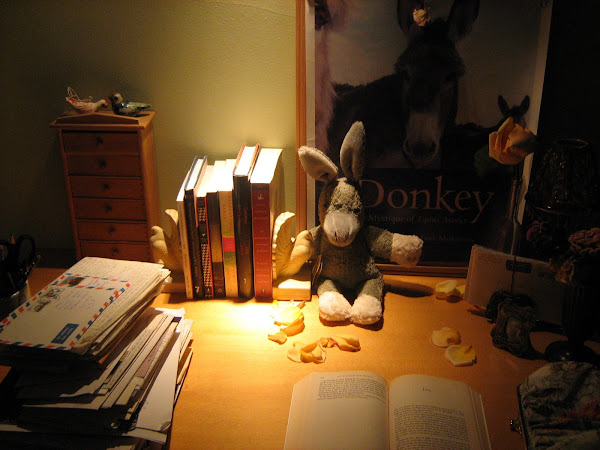
When a writer moves—which I’ve just done—a whole heck of a lot of books move with her.

Boxes and boxes of them, the first ones carefully alphabetized and labeled, and the last ones thrown into the same boxes with miscellaneous precious seashells, kitchen gadgets, and CDs, wrapped up in bed linens and towels in the fight against the deadline to get one’s house unpacked and ready to be lived in by someone else.

Those boxes of books—a weighty, three-dimensional representation of who I am—are now all stacked up in one of the outbuildings on my fiancé’s Wine Country farm.

Some of the books are ones I’ve written. But most of them are books I’ve read and loved—or haven’t read yet but want to. They’re books that other writers have signed for me (quite a few of them at Kepler’s!). They’re the books I’ve used for my research in writing historical novels.

There are about five big boxes—boxes I’m just itching to unpack—filled with reference books about 18th century Italy. These were the doors that opened my eyes and heart to the world of the foundling home in Venice where the young priest, Antonio Vivaldi of “Four Seasons” fame, served as music master and resident composer: the world of my 2007 novel from HarperCollins, Vivaldi’s Virgins.

There’s the slightly smaller but no less intriguing collection of books that empowered the research for my forthcoming novel (HarperTeen: April 2010), A Golden Web. Books about cross-dressing in medieval Europe, manuals for manuscript illumination and women healers, studies of 14th century medical practice, and lushly illustrated Books of Hours.

Some of the books were too precious to pack: the ones I’m using to research my current novel, set, again, in the world of music, this time in 18th century Vienna. I couldn’t risk having any one of these go astray.

My fiancé is also a lover of words (as well as a professional violist and vigneron). The very first piece of my furniture I found a place for inside his house was my dictionary stand. He exulted right alongside of me at the beauty of having it there, where—at any given moment—either one of us could go look something up.


Yes, I love Google and use it all the time. But there’s no replacement for the physical evocation of all those words, all that language, waiting for us, beckoning us, buoying us up above the tumultuous waves of our storm-tossed lives.

—Barbara Quick