Wednesday, June 18, 2014

Notes on Psychological Landscape Part II


This is a sequel to my previous post Notes on Psychological Landscape Part I. 


In their paper “Utilizing Complexity To Change Psychological Landscapes,” Maryann Reese, MA and Dr. Miriam R. Tausner use the landscape metaphor to show the features of psychological landscape:
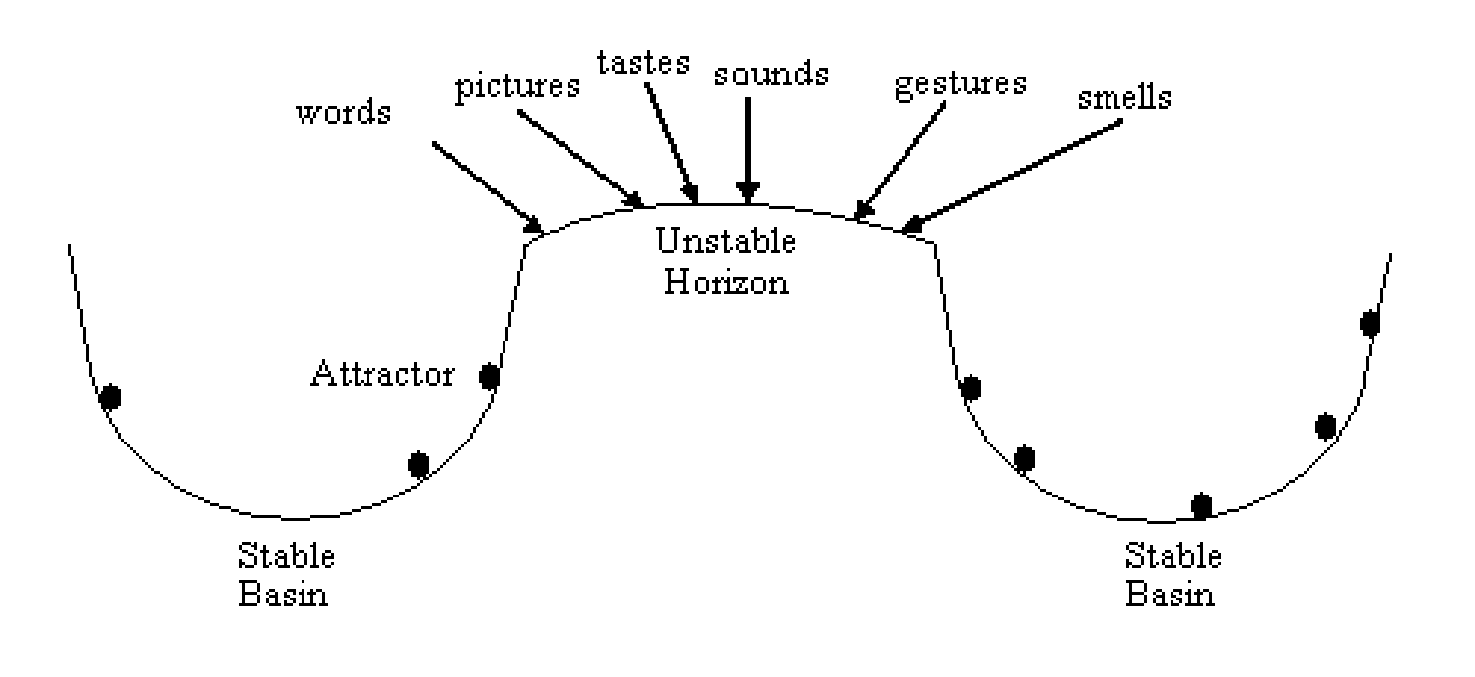


Figure I. Psychological Landscape

Psychological landscapes consist of horizons and basins of attraction. Figure I depicts a curved line with a high peak, which is the horizon, and two hollowed out tunnels, which are the basins. Horizon is a vista from which we observe our life and its surroundings.  Our outlook or angle of vision is skewed by our past experiences featured here as the deep burrows or our emotional life under the surface. A wide variety of events and sensory details make person access reference points. A reference point is a marker of an event, which is a gateway to external triggers such as (see Figure I) words, pictures, tastes, sounds, gestures, smells, etc. that propel a person to an attractor in a basin. Attractors are internal representations of original experiences; in other words the attractors pull us towards positive or negative place, depending of the nature of the original experience. Figure II illustrates this process:
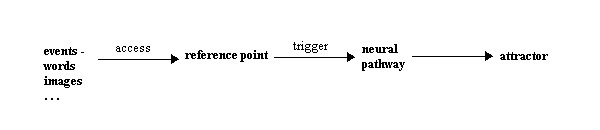

Figure II. What is the process?  

How this relates to the soldier’s photograph and the war landscape framed in the bombed-out castle wall, and my psychological landscape?

Image (castle’s ruins, soldier) → access brain’s limbic system/the core of emotions and memory → trigger memories of war destruction and exile → evoke emotions → nostalgia, displacement. 

The image of the soldier and castle’s ruins sends signals to the brain’s limbic system, which is the core of emotions and memory. The signal accesses the reference point in my past experience of war destruction and exile and creates a sensation of pain. Thus, the photograph evokes emotions of nostalgia and displacement.

This is my mother in her kitchen in Sarajevo, just before the war broke out in 1992, following up the breakup of Yugoslavia:


And this is my mother's kitchen after the war:


Psychological landscape is the invisible landscape of our mind, a panorama of our past, present and future way of thinking, feelings and behavior. We could say that the psychological landscape of the character is the character’s vision of life.  In her comments on William Styron’s short story "The McCabes," Katherine Ann Porter writes:

"Human life itself maybe be almost pure chaos, but the work of the artist – the only thing he’s good for – is to take these handfuls of confusion and disparate things, things that seem to be irreconcilable, and put them together in a frame to give them some kind of shape and meaning. Even if it’s only his view of meaning. That’s what he’s for – to give his view of life."

I thought that perhaps I could use Reese & Tausner schema of psychological landscape as my framework in writing about psychological landscape in fiction, because writers use the same reference points and sensory cues in their work to bring characters to life.  Similarly, the readers experience the text through senses in order to enter the emotional life of characters. Furthermore they draw upon memories of their own prior emotions to match the emotions of the characters. Reading too, is an emotional journey. It is not my intent to trivialize the work of psychology; my objective is to illustrate ways in which writers depict “what’s going on in characters’ heads,” the cause and effect between characters’ perceptions, emotions and behavior. By using the metaphors of landscape I intend to visualize internal and external manifestations of character’s landscape of the mind.

It seems to me that writer and reader are like two travelers. They are together undertaking a journey (that’s the story). The writer creates the character, charts the psychological landscape and setting of the story. The reader follows the map, reads the signs and symbols and learns how to experience the invisible landscape of the hero’s inner reality, or in other words to feel empathy. On the both journeys, the writer’s and the reader’s experience is based on their emotional landscape, their perception of the world, because we all identify the feelings and actions of others out of our own experiences.

Cynthia Ozicks writes in her essay “The Shock of Teapots” about the sharpened sensitivity of the travelers:

"What we remember from childhood we remember forever – permanent ghosts, stamped, imprinted, eternally seen. Travelers regain this ghost-seizing brightness, eeriness, firstness. They regain it because they have cut themselves loose from their own society, from every society; they are, for a while, floating vagabonds, like astronauts out for a space walk on a long free line. They are subject to preternatural exhilarations, absurd horizons, unexpected forms and transmutations: the matter-of-fact (a battered old stoop, say, or the shape of a door) appears beautiful; or a stone that at home would not merit the blink of your eye here arrests you with its absolute particularity – just because it is what your hand already intimately knows. You think: a stone, a stone! They have stones here too!…For the vagabond-voyeur (and for travelers voyeurism is irresistible), nothing is not for notice, nothing is banal, nothing is ordinary: not a rock, not the shoulder of a passerby, not a teapot."

The act of reading or experiencing is as important as the act of writing.  When I compare the writers and readers to travelers, I am assuming that they possess childlike curiosity and imagination and willingness to play and roam free, even to get lost. In his book "Maps of the Imagination: The Writer as Cartographer," Peter Turchi compares writer to an explorer and artistic creation to a voyage into the unknown.  I mentioned the word empathy earlier because it is an important aspect in both acts: writing and reading. Empathy is understanding and compassion towards other human beings; it means being able to identify with another’s person feelings. An Other is that voyage into the unknown.

When we embark on that trip into unknown we construct new worlds from our reading material; we envision the places and characters we read about or visually construct the new landscapes in our imagination; we see them with our mind’s eye. We inhabit the psychological landscapes of the characters and look out at the world through each character’s eyes. How do they feel about life?

Notes on Psychological Landscape Part III will focus on writers’ techniques of externalizing characters’ intangible feelings. How do we express characters’ emotional life using other methods than first-person point of view or going directly into characters’ thoughts? 


Wednesday, December 11, 2013

READING by Joyce Kiefer


I was sitting around the kitchen table with a half dozen women friends from college, and we were making a list of good reads for one of us – Donna – who was about to have knee surgery.  Donna had asked each of us to suggest a good book for her convalescence.  An avid reader, she considered her recovery time as a good excuse to read non-stop - anything -  fiction, nonfiction, history, light, heavy.   She wanted to surround herself with a smorgasbord of books.

Joan, a newspaper writer, took down our suggestions.  She queried each of us. Suggest three books, she said.  “Shadow of the Wind,” I offered. “The masterpiece by Carlos Ruiz Zafon. The very end let me down, but what a poetic, mystical ride!  The story involves a library.” 

"You'd love "People of the Book," Donna replied.  “Geraldine Brooks.”

How about "Gilead" by Marilynne Robinson ?" I started to describe its stark characters and setting.

"Already read it," said Donna.  

I ended with “The Book Thief.” “The presentation is key.  I’ll say no more.”  Neither did she.  Somehow her book club missed that best seller by Markus Zusak.  The movie hadn't come out yet.

We continued around the table.  The shocker came when we got to Jeannie.  She and I had been classmates in an honors Western Civ course.  We read everything from Homer to Wittgenstein and Hume.  I envied her insights, how she got the points that I missed.  But now all she could suggest was  "Peter Pan."  “Yes,” I said, “You must have found J.M. Barrie a fascinating writer, making an allegory of his refusal to acknowledge himself as an adult.  "Maybe," Jeannie replied.  "But my life is so busy with grandkids (over a dozen), that I don't have time to read for myself."  

I was further amazed when Mary, another honors classmate, agreed.  She has no time to read either. And Charlotte confessed she did so much required reading in college (between 3 and 6 a.m. because her roommates were quiet then), that she never wants to read another book.  She does read the paper end to end to keep up to date.

I was shocked because reading is an essential part of my own life. I assumed these old friends – intelligent women all – shared the same passion. How could they turn their backs on history, well-crafted stories, the classics, the opportunity to engage with new ideas?  Did the personal curiosity of these former teachers freeze at graduation?  

My mother taught me that reading is an art.  When I was little, she would open a new book I’d received as a gift, run her finger down the title page to flatten it to the spine, and say, “See?  It smells like a new book.”  Then she’d turn to the dedication, read it, and explain, “This is the person who inspired the author.”  Next, she would turn to the table of contents.  “Here’s what’s waiting for us.”  Finally, she would slowly turn to Page 1 and begin the story.  She taught me to savor a book, not speed through it. 


She also showed me that books are organic.  “Protect the spine, or the book will fall apart,” Mom would caution.  “The leaves are the sheets of paper with the printed page on each side and they’re made from trees.”  As she read to me, it seemed that real people bloomed from those leaves.

I’ve always enjoyed scanning other people’s bookshelves, even as a kid.  The contents tell me what their owners like to explore, the stories they treasure, the ideas that tweak their minds. 

A built-in bookshelf next to a used brick fireplace sold me on the first house we bought.  We still live there.


Chasing down a physical book is part of the fun of reading.  First of all, there’s the literary buffet offered by a brick and mortar bookstore.  On my way to the travel section of one favorite store, I had to stop and sample the cookbooks on display and thumb through the selections on the best seller table before I reached my destination. I was looking for guidebooks to Turkey but couldn’t resist Uzbekistan.   How would I get around if I were going there instead of Turkey?  What would I see?  Of what should I be aware?    Finally I returned to the Turkey shelf and looked for Rick Steves.

Then there’s the library treasure hunt.   My book club decided to read “The Poisoner’s Handbook: Murder and the Birth of Forensic Medicine in Jazz Age New York” by Deborah Bloom. I didn’t want to own this title. Anyone snooping my bookshelf might suspect a Lucrezia Borgia side to my personality.  I didn’t want the book on my iPad, either.  Something contaminating about that.  All the copies were checked out of my local library.  I had one alternative: the library at Stanford University where I have borrowing privileges.  What could be sweeter than the joy of wallowing in seven million books?  

The Poisoner’s Handbook was available but I had to hunt it down somewhere in the basement of the main library. Once I stepped down there, I followed the arrows along a dimly lit aisle to the South Stacks.  Then I stepped round the corner into a darker underground wing.  Finally I found the right neighborhood of call letters, but my number range was missing.  I refused to give up.  I spotted a couple of aides with a book cart.  Surely one could help but I thought how strange it would be to say, I’m looking for “the Poisoner’s Handbook.”  Can you help me find it?”  Perhaps one aide would chat me up while the other pushed a panic button.  Or they would wave me off to the Chemistry Department.  But I was on a mission and I finally found the Poisoner’s Handbook on a lower shelf in a dark corner.

A friend who’s an engineer said no one needs books anymore.  Everything is on the internet and the young generation knows this.   But my ten-year-old granddaughter would disagree.  She inherited the bookworm gene.  Her friends know she loves to read and gave her gift cards for her birthday to the one bookstore in her town.  She showed me the stack of books she chose, picked one up, and read me the story outline on the flaps. 

“Tempt me,” I said, as we were eating lunch.  “Read me a little bit of the first chapter.”  She opened the book carefully, smoothed down the page, and began to read.


Joyce Kiefer is a long-time member of the A-Z Writing Group formerly known as Kepler's Writing Group.  Her poetry has been published in several anthologies and she writes columns for several websites, as well as her own blog: http://lifeinthepursuit.blogspot.com/


Sunday, April 15, 2012

James Chandler: Titanic Centennial Celebration


Bowker's issued a press release about the 98 books published for the Centennial of the Titanic's sinking. Most seem to look at the same event from different angles or work with Cameron's version. No one attempts to change the outcome -- until this one.


Want to read a happy ending, an alternative that could have transpired even with no change in the surroundings that night? A man coming of age, a love he's just met, a challenge he meets in an unconventional way, turning his odd vision into a beacon for survival.


Read the story here for free:

ADRIFT, by James Chandler

James Chandler is the editor of Fallen Leaf Anthology (twenty writers attending The Write Retreat at Stanford Sierra Camp collectively present more than 40 works of fiction, nonfiction, and poetry) and long time member of Kepler's Writing Group.

Friday, April 13, 2012

Jennifer duBois: Mental Distress Across Culture and History


    The New York Times Magazine recently ran a fascinating article about the group of teenage girls in upstate New York who succumbed, en masse, to a set of mysterious symptoms—such as twitching and spasming—for which no satisfactory biological explanation can be found. One girl was afflicted with the symptoms, then another and another, until the affliction has spread fairly widely throughout the school. Many of the sufferers are cheerleaders. The story has attracted much national attention, and the incidence of the symptoms seems to rise and fall with the level of media scrutiny. After ruling out environmental explanations, some experts have concluded that the girls are suffering from conversion disorder—commonly called mass hysteria. But perhaps understandably, many of the victims and their families are resistant to this diagnosis, in part because it sounds like an accusation that the girls are faking their symptoms—and their symptoms, it turns out, are pretty hard to fake.

     Reading this piece reminded me of an amazing book I read a couple of years ago called Crazy Like Us: The Globalization of the American Psyche by Ethan Watters. In it, Watters argues that mental illness, unlike physical illness, manifests itself in culturally distinct ways. In different cultures, different symptoms are scanned as reflective of psychic pain—and thus, in different cultures different symptoms of psychic pain appear. Watters argues for a more culturally aware approach toward global mental health, raising the interesting example of schizophrenia—understood as the product of malfunctioning brains in the West, and of demonic possession in certain African cultures. In those cultures, because the problem is understood as external to the individual, schizophrenics are more accepted and well-integrated into their families during periods of wellness and calm. Watters also discusses the case of anorexia, which is widely and popularly believed to be a function of the Western media’s obsession with image and emphasis on thinness. But he raises the point that when anorexia first emerged as a set of symptoms it was not often accompanied by the body dysmorphia we often believe to be its hallmark today—it usually afflicted a young woman on the heels of a romantic heartbreak, and first presented as vague stomach problems and an inability to eat. A similar disorder is arising among young women in Hong Kong, where the disease is not understood—at least not by its sufferers—as a pursuit of thinness, but is in fact experienced as a sensation of chronic stomach discomfort or fullness.

      I was reminded of all of this while reading the article about the cheerleaders in upstate New York. When no external and organic explanation for the girls’ symptoms was found, sufferers were understandably hesitant to accept the diagnosis of conversion disorder—feeling that this was, on some level, an implication that their disease was not real. Crazy Like Us gives us another way of understanding their symptoms: as a culturally influenced manifestation of an underlying, and very real, psychic issue. It shouldn’t surprise us that symptoms of mental distress are variable across culture and history, or that certain mental symptoms can be unusual, transitory, or even, on some level, ‘contagious.’ After all, the brain is in constant dialogue with the culture around it, which makes diagnosing and caring for it an even stranger project than caring for our bodies.  My mother tells the incredible story of how, as a young candy striper volunteering in a V.A. hospital, she roused a catatonic patient from his stupor by offering him a glass of what she thought was apple juice—it was, in fact, his urine sample. His vigorous head shaking was his first movement in months, and he subsequently made a dramatic and full recovery. Though for some reason, this never made it into the medical protocol.

Wednesday, April 11, 2012

Jennifer duBois: When One Falls In Love With a Book


     Really loving a book—especially one that not everyone else in the world has read—comes with a very particular blend of emotions. There’s the feeling of private elation, as though the book’s been written for you personally. There’s that impulse to babble to everyone about how much you loved the book. And there’s the sense of gratitude that, out of the vast universe of books, this particular book happened to find you. All of these feelings are heightened, I think, when one falls in love with a book that has, in one way or another, only recently emerged and become available to you—either through a translation or an exhumation or a re-release. Over the past decade, I’ve read three books of this sort that have particularly stayed with me: Embers by Sandor Marai, Desperate Characters by Paula Fox, and There Once Lived A Woman Who Tried to Kill Her Neighbor's Baby by Ludmilla Petrushevskaya.


     Desperate Characters, originally published in 1970, was re-released in 1999 after many years out of print. It’s a prickly and perfect little book, written with economy and grace and wryness and an astonishing command of our sympathies. Fox skewers the solipsism of her characters—Sophie and Otto Bentwood, fragile inhabitants of late-60s New York—without ever abandoning her empathy for them, and she’s a master of strange and chilling and small domestic symbolism (the plot mostly revolves around Sophie waiting to find out if she’s contracted rabies from the bite of a stray cat). Sophie and Otto’s lives provide the perfect canvass to delineate, with wrenching clarity, the changing social and political landscape of the time. Desperate Characters is that very rare thing—a social novella, no less wise and prophetic for being so slim.  


     Embers was written in Hungarian in 1949, fell out of print forever, and was translated into English in 2000, eleven years after Marai committed suicide. It’s an enchanting and haunting novella, told mostly as an elegant monologue—and extended accusation— delivered by an aging general to an old friend he’s invited over for dinner. The fact of the general’s direct address invites us to feel implicated in the events he describes—and I think in a strange way this device manages to subvert the possible artificial coyness of withholding the revelation of what’s occurred. By telling us what’s happened as though we already know, we sort of feel as though we do. This book feels like a fairy tale in the very best way, and its emergence from obscurity (and Hungarian) adds to this mythic feel. 


      There Once Lived A Woman Who Tried to Kill Her Neighbor’s Baby is a collection of stories that were selected and translated into English by Anna Summers and Keith Gessen and published in 2009. Though widely known in Russia, this collection was Petrushevskaya’s first English translation from a major American house. The stories are deeply strange and spare and utterly singular; they grapple with the inexplicable; they careen from dreaminess to nighmarishness, and from the literal to the metaphorical, and back again. They straddle realism and surrealism in a way that is both disturbing and gorgeous; one is always left wondering, deliciously, what kind of story one has just read. 
     All three of these books would be lovely and thrilling no matter what—at any time, and in any language. But the fact that they’ve only recently become accessible to me, as a reasonably young reader of English, makes them—at least to me—even more intoxicating and compelling. 

Monday, April 9, 2012

Jennifer duBois: How should one proceed when the cause is lost?


Not long ago, I was asked in a radio interview what I might do if confronted with the situation my character, Irina, finds herself in A Partial History of Lost CausesGiven a diagnosis of impending Huntington’s disease--the fatal neurological disease that she’d watched slowly kill her father—Irina runs away from her life. She leaves her boyfriend and mother and job and friends, and she goes to Russia to ask Aleksandr Bezetov (a chess champion turned dissident, loosely based on Garry Kasparov) a pretty abstract question: how should one proceed when the cause is lost? In the book, the tenuousness of Irina’s links to her life—most importantly, her relationships—allows her to go on this strange last adventure. Might I do something similar, the interviewer asked, if I were in Irina’s shoes? How might I look for meaning? I said that I’d have to run away to Russia to find Garry Kasparov, of course, but that was not at all true. The question made me contemplate Irina’s profound and distinctive isolation, and the ways in which this feature of her character enables the book’s plot. And the experience of promoting Partial History has reminded me (as if I could ever forget), how very different I am from Irina on this score—and how the existence of the book itself, and Irina in particular, feels to me to be a very communal effort.


The truth is, I think I would probably do the opposite of what Irina does if I was in her situation: I imagine I would cling to my fiancé and my mother and my friends; I would tediously invest in my relationships; and though I’m sure I’d share a huge portion of Irina’s self-pity and fear, her philosophical concerns (even for a former philosophy major like myself) might, at the end of the day, turn out to be pretty low on my list of priorities. This would probably be a typical response; after all, millions of people confront the exact same diagnosis as Irina without doing anything so dramatic and self-indulgent as she does. But I wanted to write a story about someone who does do something dramatic and who is propelled by the abstract, and that meant writing a character like Irina: isolated in the extreme, at least at the book’s beginning, and unable to invest (or so she thinks) in much of anything—even though she recognizes, on some level, that her problem is really everyone’s problem (namely, mortality).

It’s been interesting, then, for me to read from the point of view of such a remote person to bookstore crowds composed overwhelmingly of my relatives and teachers and friends and friends of friends and parents and cousins and in-laws of friends, many of whom contributed to the book in ways known and unknown to them: the Iowa classmate who gave me brilliant line edits and the fourth grade teacher who let me write stories with spelling words instead of taking spelling tests; the Stanford colleague who directly solved a second chapter problem and the great college friend/ghost publicist who tirelessly promoted the book to everyone, everywhere; the hugely talented high school buddy who took my author photo and the inspiring history teacher who pushed me to deal with my public speaking fear; the tireless Alzheimer’s home health aide, who gave Irina her pragmatism; my widowed mother and widowed aunt, who gave Irina her resilience.

In A Partial History of Lost Causes, Irina’s isolation grants her a freedom to do things that—at least narratively, and at least to my mind—are more interesting than the things that most normal, reasonably socialized people might do in her place. So I’m glad that Irina is a solitary person. But I’m also glad that I’m not. Because standing behind Irina—even though she doesn’t know it—is an entire army of people I’ve learned from and loved. And they have made both of us possible.

Wednesday, June 22, 2011

C. J. Noonan: What a Newly Published Author Learns


“Evocative” is a powerful word in a book review. The critic implies mystery, depth of feeling, swell of remembrance, emotion rising. Readers assume fascination, excitement, complexity, sensation. As a new author, I value the adjective. It guided my writing.

“An evocative first novel from C.J. Noonan begins in the rough, early 20th century Sierra Nevada outpost of Truckee, California. It chronicles the tumultuous growing-up years of five children during the California woman’s rights movement and closes with the startling understandings of a good woman’s life, lived long.” These words are used to describe my novel, The House on Harrigan’s Hill.

A novel contains memoir and imagination. My novel’s characters, called “animated, no wooden, lifeless personalities…” from one reader’s brief Amazon review, are based on my grandmother’s early life. The events happened, told to me many times by my grandmother. Settings in the book come from places I know well in Sacramento, the Sierra Nevada, and Truckee. Beloved objects in the story decorate my home today. But these are all carefully chosen from among many events, scenes, and furnishings to add insight and to interpret the particular characters, landscape, and actions of the story. The novel is a doppelganger; two sides of a coin; or as the protagonist says things “remembered … one way and Tiny had a completely different memory.”

First time novelists are urged to block out a careful sequence of action that builds to a climax and resolves the conflicts in a denouement. They are told to spend time making character outlines. And some writers do. I used a more chaotic method. I just wrote and new ideas rolled out of my mind as the sequences developed. I moved sections around and rewrote as a new angle came to mind. I spent time thinking about what was going on in the character’s head to make them act a certain way. I recalled that the real “Mama,” my great grandmother, was a fountain of poems, lines from Shakespeare, and sayings from the Bible, so I molded that character to include those traits. They make her unique, which she was.

At workshops, on the internet, and from friends the advice was “get a reader.” The college writing professor friend who read the novel through many drafts helped beyond compare. She refers to me as one of her successful “mentees.” How lucky I was!

The Bay Area Writing Project’s emphasis on reading a draft and accepting the expert advice from colleagues was invaluable. I remember Jim Gray (first Writing Project director and friend) who promoted teachers as writers. From his words of wisdom I learned that a writing group is a must. The five pairs of eyes in my group, reading the same chapter I’d struggled over for weeks, suddenly provided a solution to a perplexing, seemingly irresolvable problem. That’s essential for every novelist, and especially a first timer.


The House on Harrigan’s Hill took four and a half years to write, rewrite, and rewrite again. Yes, I took vacations, worked on senate and presidential elections, wrote short stories and weekly posts to my education blog, attended the many plays offered in the Bay Area, and generally lived my life. But the novel was in my imagination day and night.

It was frustrating that agents and publishers did not immediately see a sure winner in the novel set in early 20th century California, filled with quirky, quixotic characters living during social and economic upheaval high in the Sierra, with a climax at the time of the election for the Woman Suffrage Amendment that gave California women the right to vote.

The House on Harrigan’s Hill was published by Sea-Hill Press. It’s available at Kepler’s and Books, Inc (Mountain View) as well as Amazon. Word of thanks to the Los Gatos Library, first to put it on the shelf. And thanks to friends and relations who have spread the word about a new author and a wonderful book. They speak the magic word: “Evocative!”

-Claire

Saturday, March 26, 2011

Meg Waite Clayton: In Praise of Writing Friends … and Publishing and Bookselling Ones, Too

The history of my writing starts with a purse. Like the character of Linda in my second novel, The Wednesday Sisters, my first writing teacher—at a college extension class—dumped hers out over the table and told us to write for five minutes about anything that spilled out. She swore we wouldn’t have to read (just as Linda does in The Wednesday Sisters when she’s pushing the sisters to write at the picnic table in the park). Then she called on me to read first.

Which is the good news. If she hadn’t, I’d have ducked out before she could. It had taken all the nerve I had just to get to that class, to admit that, yes, I dreamed of writing novels.

To make a long story short from that point, I’m just going to say it: Ten Years. That’s how long it took me from dumped purse to first novel on bookstore shelves. The thing that kept me going: writing friends. Like the Wednesday Sisters in the book, none of my early writing friends was published when we started out, but we now count - as of the publication of The Four Ms. Bradwells yesterday - seven books between the four of us, and an eighth under contract. We’re a stubborn bunch—which, if you’ve read any of the guest posts I’ve been honored to host on 1st Books—seems to be what it takes. So it seems fitting that the first Four Ms. Bradwells sighting was by my best writer-pal, Brenda Rickman Vantrease.

It took me another five years to get a second novel published after my first, The Language of Light, sold "modestly." (I'm absolutely thrilled, though, that Ballantine will be releasing it in paperback for the first time this June.) In the interim, I learned the hard way that while just being published is lovely, book sales are important, too. I have come to see that booksellers are the front line in helping new voices find audiences, and I do my best to support the booksellers who support writers. Selling books is as much a labor of love as writing them is.

And so is publishing. I know the publishing world can seem impersonal. Believe me, I know what a form rejection looks like. But I also know that most people in publishing stay there because they love books, and work really, really hard. I feel incredibly lucky to have a wonderful team helping me negotiate the turbulent waves of these changing publishing days.

Which leaves me with readers.

C.S. Lewis once said, "We read to know that we are not alone." It's a funny thing to think that a solo activity connects us in ways that little else does. But I know reading has made me feel understood, and helped me understand myself in ways that nothing else does. I hope that my writing will make you feel understood, too. And I appreciate all the precious time you commit to reading. Without readers, there would be no books. - Meg

P.S. If you're leaving here to take a look at The Four Ms. Bradwells - thank you! And will you take a look at The Peach Keeper by Sarah Addison Allen as well? It came out yesterday, too, and is a wonderful novel. Thanks!

Monday, March 21, 2011

Treasures of the Mind


My third novel, The Four Ms. Bradwells goes on sale tomorrow, and I'm so looking forward to sharing the joy of that at Kepler's, where friends will be gathering for refreshments and a short reading. But I'm going to be spending so much time talking about that at so many readings over the new weeks that I thought I'd use today to talk about some of the things I've been reading. I've just finished The Peach Keeper, a lovely novel by Sarah Addison Allen. It, too, goes on sale tomorrow - I hope everyone who takes a look at The Four Ms. Bradwells will take a look at it.

And like everyone else, I suppose, I've been glued to the news - Japan, Libya and Cairo and Bahrain - and sometimes wondering what good writing does in this kind of world. But for a reassuring answer to that, I turn to the wonderful historian, Barbara Tuchman, who said

"Books are the carriers of civilization. Without books, history is silent, literature dumb, science crippled, thought and speculation at a standstill. Without books, the development of civilization would have been impossible. They are engines of change, windows on the world and lighthouses erected in the sea of time. They are companions, teachers, magicians, bankers of the treasures of the mind.

Books are humanity in print."

And so I'm doing my best to set my light glowing at the top of my lighthouse, to shed what light I can. - Meg

Wednesday, July 7, 2010

Belle Yang: My Life, My Family, My Graphic Memoir in Snapshots

I will be at Kepler's at 7:30 P.M. July 8th talking about the process of making a graphic novel. Please join me.


***********


A drawing from 1967, the first year of my family's arrival in America. I like to show school children I wasn't drawing any better than most of them. The scene is of San Francisco Chinatown New Year's parade. Bing, Bang, Bong! Loving comic book sound effects at an early age.


***********


My parents and I moved to Carmel in 1971. I was lonely the first summer and Nancy Johnson, a professional watercolorist, who lived across the street, took me in her green VW Beetle to join her elderly students sketching and painting at Point Lobos and Cannery Row. The latter was no tourist destination. It was still the real Cannery Row of John Steinbeck.


**********


Self-portrait in my studio with my cat, Chairman Mao. Mao is a homonym for Mao--Cat (different tone. In Mandarin, there are 4 tones). You'll find him in my graphic memoir, "Forget Sorrow: An Ancestral Tale." He appears in the present and in the past, because I wanted to connect my father to my great grandfather who were spiritually atuned.


************


During my three-year sojourn in China, I studied traditional Chinese painting from contemporary masters. There he is, Chairman Mao sitting on his bistro chair.


*********


My studio at night.


********


I use pigment markers for shading and hatching. Pigments do not turn blue or purple with age. This ensures my art work remains unchanged. I continue to do everything by hand. Some artist draw with Photoshop, but this leaves them with no original art. Perhaps they retain merely the sketches, which were scanned into the computer to begin the art work. Maybe not even sketches. I feel rich when I have stacks of art work under my bed, in the closet.


***********


A tube of gouache (pronounced goo-wash). It's an opaque watercolor and gives me the richest black. I prefer lamp black to permanent black.


***********


An Ames guide allows me to draw parallel lines. They corral my uneven lettering. But my lettering is hardly as good as it was in grade school. WW Norton decided to digitalize my handwriting, so I have a Belle Yang alphabet. It looks good. I had to do a double-take when I saw my pages with the new alphabet inserted in the captions and word balloons.


************


A graphic novel page in the works.


*************


Taping off an edge of a panel so . . .


I can paint a straight edge. But I rarely use this trick, because my hands have gradually grown steady and I can make a straight edge free hand.


***********


Having a little show on the carpet of the living room with my dad watching on. It's so satisfying to spread out a bunch of the work and see how far I've come.


*********


Asked to try my hand on the jacket art, I drew these two pieces. As you can see from the published book, we went in an altogether different direction.


**********


The last page--"Finis!'


And Matt my loyal Fedex man comes to take it all away. It still amazes me my precious art, the results of 14-years, can reach New York City in less than 24-hours.


*************


My great granddad, Yang Junchen. He is the tragic hero in "Forget Sorrow."


**********


The Yang Family resettled in Tianjin during the mid-1930s after the Japanese attacked Manchuria.


***************


My father Zu-Wu, or Joseph Yang, and me. This was taken in 1994 when my first self-illustrated, adult nonfiction book, "Baba: A Return to China Upon My Father's Shoulders," was published.


***************


Laning and Zu-Wu. My parents on their engagement.


A life-long partnership.


***************


My next project will be on my mother's Hakka tribe on the Island of Taiwan. Hakkas were pushed out of the north in the 3rd Century by horse-riding peoples of the steppes. Hakkas in turn became nomads and are often called the Jews of China. My grandfather was adopted by a Japanese family when Taiwan was a colony of Japan (1985--1945), thus the kimono.


THE END

Tuesday, July 6, 2010

The Tao of the Graphic Novel

Belle Yang Interviews Belle Yang


Before we begin today's Q and A, please click here to watch this 4 minute film in which I am drawing a graphic novel page.


Q: Ms. Belle, are graphic novels all fiction?


A: Well, Belle, this area of art/literature is still being defined as it develops, but I asked my friend the librarian Ruthie Pennington Paget who is my go-to gal pal. This is what she says:

Comics are non-continuous, short stories that you find in a newspaper.

Graphic novels are book length, but they are their own format, which uses the methods of movies for presentation. They are the fiction format.

Graphic memoirs are a non-fiction genre of the graphic format.

The graphic style is a new format with fictional and non-fiction content.

Graphic style = cup. Non-fiction and fictional work are different kinds of ice cubes.

So, you got it? I am actually more rattled. I’ve read “Graphic Novels for Dummies” and it says graphic novels encompass fiction and non-fictional works as in memoirs. And some creators would be outraged to be called graphic novelists when they prefer the aesthetic simplicity of being creators of comics. Some just want to be called cartoonists. Manifestos have been written about what comics should mean. Manifestos? I thought they were only for Communists. Is Communism the root of all comics?

Q: Ms. Belle, what are a few of your favorite graphic novelists


Okay, the obvious ones are Art Spiegelman and Marjane Satrapi. Then there is Alison Bechdel’s “Fun Home”—oh, she is just so literary and laugh-engendering even in as quirky a setting as a funeral home. How can you get literary in a comic book, you ask? You can. She does and I do or at least I try to be.

There are historical comics like the Canadian Chester Brown’s “Louis Riel.” Now that’s an area I want to see grow—biography and history. Comics grow up.

“Stitches” by the Caldecot bemedaled David Small. Josh Neufeld—and I am raring to get my hand on his “A.D. New Orleans after the Deluge.”

There is Joe Sacco’s journalistic approach in “Palestine” and “Gorazde.” He’s great, even if his characters were drawn by an overzealous dentist.

Seth’s “It’s a Good Life if You Don’t Weaken,” about the main character’s obsession to discover the past of a dead New Yorker cartoonist. Seth's drawings are loose-limbed and stylish. Yes, some people get to go by one name because they are special.

Oh, not to forget David B.’s “Epileptic.” He’s French, so he gets to be just David B. (That’s Daveeeed to us uncouth Americans.) His drawings are stunning, marvelous. They make me wish I had made them. His story is painfully personal, about life with a brother who suffers grand mal seizures. Their parents’ attention is focused on the child with the problem. You get the picture. David has to live with the horrid N word: Neglect.

And I could tell you about the graphic novels I don’t love, but I always stop myself from being negative about another maker’s opus. This is my pet peeve: if it’s a bad book of any genre, it will die a natural death. Don’t throw dung at it. We need to review the good ones. Leave room for the idea that all your taste may be all in your buds?

Q: How did you choose the comics format?


A: It jumped out at me in a dark alley at a dead-end. It truly did.


I lived in Japan as a child and was devouring the telephone book-sized manga for girls and came to the US in 1967 wearing my favorite manga character shoes. Now in middle age, the manga phenomenon has washed over this continent like a tsunami.

As I mentioned in yesterday’s Well-Read Donkey post, I had a tough time selling my prose book with full color illustrations. In the eleventh year of my struggle, I reconnected with Alane Salierno Mason, my former editor at Harcourt Brace. She had moved to WW Norton and Company, and she suggested I take a look at Marjane Satrapi’s “Persepolis.” I did, and KAPOW! I was knocked over madly in like with the comics format all over again. I said, hey, I can do this, and do it well. So I turned my prose work into captions and dialogues, drew the pages in panels of art then showed them to Alane. Norton offered me a contract in the fall of 2007.

Q: Why do you work in black and white. Are you giving up color?


A: Ms. Belle, you know very well this question sends me into a tizzy.

As far as I can remember, I've loved black and white art. It began with black crayons on white sheets of paper on the backs of mom's students’ exams. When someone mentions comics, my mind flies to black and white inky panels, not color. Black and white has it's own set of parameters and design issues. Black on white is ecstatic. The two "colors"--one being the total absorption of light and the other, the throwing off of all light--are polar opposites. It's thrilling, its ecstatic, it's exhilarating. It's drama and conflict. Durm und strung.

Think about the first mark you make on a pristine sheet of paper. The abrasion of the black crayon or pencil is like an explosion in the cosmos, the moment when matter comes into existence.


Q: Ms. Belle, how should someone new to the graphic novel approach the reading of the first one?


A: I am always surprised by this question, because I learned to read manga when young, so it’s as natural to me as eating rice. You can do it any way you like: read it fast and come back to study the details. Or linger over each panel until satisfied and go on to the next. I can’t begin to break down my eye-brain functions, but I imagine I scan the panels and the entire page.


A graphic novelists like Chris Ware in his “Jimmy Corrigan: The Smartest Kid on Earth” asks us to scan the whole page, because he wants us not to read in the usual way of moving our eyes left to right and top to bottom. He requires us to take in the whole and then home in on the details within the panels. You eyes will get a lot of exhausting and exhaustive exercise when you read graphic novels. It’s not kid’s stuff. Oftentimes, you have go back to find the trail of white pebbles, like Hansel and Gretel, in order to find your way.


And no, you are not stoopid if you missed it the first time round. Reread, reread and reread.


Q: Why did you use a brush and gouache instead of markers or pen and India ink?


I’m Chinese. Chinese love the brush. Therefore, I love the brush. Chinese culture is inseparable from the brush, since Chinese calligraphy is defined as the Mother of all arts. (I’ve heard Westerners refer to calligraphy as the art of the dunce. Hey, don't frown at me: I didn’t say it.) The brush can be supple or energized. It is able to express the artist’s every emotion, whether it be peace, rage or elated trembling.

With gouache, an opaque watercolor, I can get the darkest velvety black. India ink can crack. It’s not as supple after it dries on the Bristol board and causes the paper to warp. Nothing uglier than warped art.


Q: Why do you say the Chinese horizontal scroll is like a pre-modern motion picture. How does it relate to the graphic novel?


When you go into Asian museums, you might see a horizontal scroll unrolled in its entirety under glass. This is the wrong way to look. Horizontal scrolls were hand-held devices. Intimate. You unroll a section to the left and roll up what you’ve seen on the right. It’s as if you are riding on the back of a donkey and you get to travel the landscape, entering the mountain, descending into a village, crossing a bridge, getting into a boat to float downstream . . . the boat goes over a waterfall (Uh, just checkin’ to see if you are still with me.)

This is exactly what I try to show the reader of a graphic novel. I take my reader into the landscape of my story. And I might add that scrolls have lines of poetry written directly into the silk or paper, just like captions in a graphic novel.


Q: Why are you nuts about this format?


A: Because it’s perfect for me. In my prose books, the two-dozen pieces of art got lost. In my children’s book, the art was dominant partner. In graphic novels, words and images come together in a perfect balance and neither overwhelms the other. And how cool is that to be make ice cubes to fill a largely unfilled cup. My cup runneth empty is a good place to be.


Q: What are you going to blog about tomorrow, Ms. Belle?


A: I’m taking you on a photographic visit of my workspace and the tools of my trade, which includes empty, white tofu containers. And the latter has zero to do with being Chinese. I also want to show you family pictures of ancestors. But I have 24-hours to change my mind.