Friday, September 25, 2009

Masha Hamilton's Guest Post: Passion


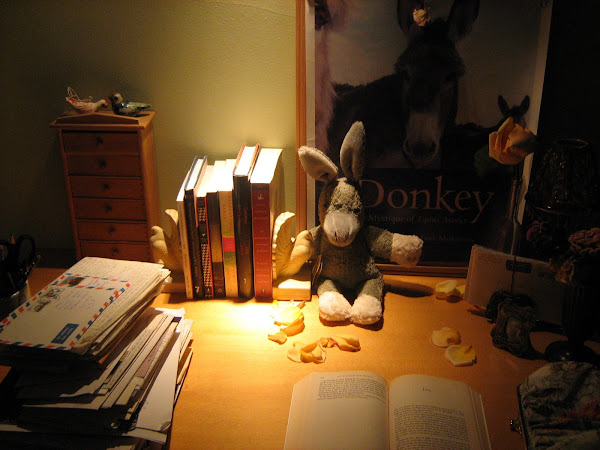
Well-Read Donkey Bookshelf at Kepler's with guest bloggers books and their reading recommendations


Earlier this month, I had the good fortune to be on a panel in Chapel Hill, NC, with Robert LeLeux, who wrote The Memoirs of a Beautiful Boy and is as moving and amusing in person as he is in his memoir. When I first got word of the pairing with Robert, I considered this another one of those mango-and-peanut-butter author mixes for which literary festivals are famous. For example, I was recently on a panel about the future of Southern Women Writers, though I was born in the Arizona desert, lived a decade overseas, now reside in Brooklyn, and have no more than passed through the South. (I like the South, though, and adore fellow panelists Janis Owens and Cassandra King. I sometimes imagine the people who create these panels gathering around a wooden table with a few dozen bottles of wine, a dart board, and all of our names on printed sheets, intent on getting a laugh somehow during the intimidating and grueling process of organizing a festival for writers and readers.

On the face of it, Robert and I are very different writers. My four books are novels, often on serious topics and with an international bent. His is a poignant American memoir and in some passages, a laugh-aloud look at life.

Yet our panel topic was passion, and its place in our work, and on this we found a lot of common ground.

Beginning and not-so-beginning writers are told to write what they know. Some have amended it to say: write what you’d like to know. But perhaps the adage actually should be: write what you care about. Deeply. Write what wakes you up at night, what you don’t understand, what makes you laugh so hard you cry, what you wish you could turn away from but can’t. Write to discover, not to expound.

The first reason to incorporate those deepest personal concerns in our writing, be it fiction, non-fiction or memoir, is that it invariably makes the work stronger. If this is the stuff that matters to us, we stand a better chance of getting our readers to care also.

But the second reason is actually more important, in my view, if more private. It is very old news by this time that publishing is in turmoil, uncertain what the future—even six months from now—will look like. Content has been devalued. Websites that demand writers to write deeply, or research broadly, or report diligently, still have no business model in place, and thus no way to pay those writers for their work, or even ensure their own continuation. In this climate, editors often find it safest to reject a manuscript. A good friend and dynamite literary writer recently told me she’s having trouble publishing her next novel because her “numbers aren’t good enough.”

And yet, many of us can’t stop writing. We write when happy or sad, we think in stories, we’re on the hunt for the subtext and telling gestures, and we feel compelled beyond our control to search for the fresh, well-turned phrase.

For some of us, in fact, writing—and reading—is spiritual work; it’s how we interpret our world, understand our lives, maybe even try to make ourselves better humans. To achieve that, we have to write about what makes us avidly curious or angry or frightened. We have to write with an unwillingness to settle for simple answers, an enthusiasm for embracing flaws, and the desire to see deeply and non-judgmentally into the Other.

This is what creates writing that is honest and authentic, perhaps with a shot at getting published, maybe getting read, maybe briefly impacting another life. And sometimes, if we’re very lucky, it draws us to others (like Robert, or my inspiring editor Fred Ramey at Unbridled Books who share our sentiments about the potential of words to take flight and connect.

It is also the work that can continue to feed us emotionally and psychically during the days and months of countless revisions or rejections, when the paragraphs buck us or our characters have fled underground or the computer eats a chapter or someone wants to discuss our numbers, when we’re distracted by loss or joy or fear and the only way forward, after all, is to write, write again, keep writing about what makes us passionate.

Wednesday, September 23, 2009

Masha Hamilton's Guest Post: Love Song To Artists’ Colonies

I’ve only twice been able to organize my life in such a way that allowed me to drop out of it for a month, but both times have resulted in astounding and memorable experiences. One, I’m convinced, directly impacted the way my latest novel, 31 Hours, turned out. The two colonies I’ve visited are Yaddo and Blue Mountain Center, both in New York State, easily reachable from my Brooklyn home. (We don’t own a car: I want a place I can reach by Amtrak.)


Yaddo, right outside Saratoga Springs, was my first colony experience. For those who don’t know, when accepted to a colony, you go free of charge and you receive a room, three meals a day, and privacy to work. In the case of Yaddo, they also gave me $1,000 toward childcare for my three kids while I was gone. The evenings tend to be communal, with a shared dinner and activities that invariably arise afterwards. But the days are loaded with silence and privacy.

Just being at Yaddo was an amazing gift. Collectively, the artists who have spent time at Yaddo have won 61 Pulitzer Prizes, 56 National Book Awards, 22 National Book Critics Circle Awards and a Nobel Prize. I felt completely humbled, but determined. I got about six months worth of work done in that single month. So that’s one way artists’ colonies impact novels: they allow them to get finished!


Yaddo (named by one of the children to rhyme with “shadow,” as the story goes) was founded in 1900 by Katrina Trask, herself a Brooklyn-born poet, and her husband, financier Spencer Trask . The couple lost all four of their children in infancy or childhood, so decided to turn the estate into a retreat for artists. Spencer died in a train accident on New Year’s Eve 1909. Katrina died in 1922 and is buried on the grounds.

So of course, Yaddo is haunted. But in a good way. Every day, when I got to a sticking point in my work, I went into the magnificent piano room to keep writing, taking a yellow pad with me. After an hour or two of working by hand, I would return to my room and laptop. On my way out of the room, I would pause briefly before one of several life-sized paintings of Katrina in the mansion, her curls piled atop her head. “Thank you,” I would whisper. One day, a vase in front of the painting trembled audibly. I could never make it happen again; It was, I’m convinced, Katrina saying: “You’re welcome.” That’s my story, and I’m sticking to it.

I have other Yaddo stories—one about a flying squirrel, another about a Ouija board—but I’ll save them for some other blog.


A few years later, I went to Blue Mountain Center, in the Adirondacks. Blue Mountain is very strict: no cellphones allowed, and the only Internet connection is in a musty basement room underneath the kitchen – they want you to forego the distractions of your daily life, find harmony and focus on work. I went with only a few pages written of 31 Hours and while there, I wrote the entire first draft.

I needed to be away from my home, in a small room overlooking the nonjudgmental Blue Mountain Lake, I believe, in order to write the first draft of 31 Hours. In that room for those four weeks, I lived and breathed the story that was revealing itself to me. I wrote letters to the characters, argued with them, found myself struggling with tears and nightmares as I wrote about their lives. I don’t think I could have submerged myself that deeply into the story at home, given the demands of regular life.

I also believe completing that initial draft in one rush of 28 days contributed to the driving pacing of the story—a pace I believe necessary in this case, part of the story’s “voice”—and that it would have turned out differently I’d written that draft over many weeks and days.

Thank you, Yaddo. Thank you, Blue Mountain. And for any writer whose story is pressing against them, but who cannot find the time in between the distractions of daily life, consider the colony.

Monday, September 21, 2009

Masha Hamilton's Guest Post: 31 Hours


Many thanks to Aggie and Kepler’s for inviting me to blog here about my new novel, 31 Hours. I feel fortunate to be in such great company of readers and writers. I’m going to do three blogs covering marketing, money and love. I’m starting with marketing because I’ve become intrigued by book trailers—by what they can do, and what they can’t—and I wish we were all in a room together to discuss it.

Because I come from a background that included both television and radio, I grew interested early in the idea of reaching beyond print to draw in readers. In 2003 for my second novel, The Distance Between Us, I put together an audio recording with crucial help from my husband, who works for NBC and MSNBC. In 2006 for my third novel, The Camel Bookmobile, we pulled together a video from my visit to the real camelback library in isolated northeastern Kenya.

Still, none of this quite prepared me for the full-on book trailer, which somehow seemed both more complex and, simultaneously, not complex enough. Here’s what I kept stumbling over: I love novels. They incorporate an overlaying web of ideas and questions, a crescendo that builds as the pages turn. Many of us spend years writing our books. How can we, on a shoestring budget, condense this layered ocean of fictional life into a 120-second book trailer that works?


31 Hours, for example, is about missed connections. It’s about how we parent our young adult children, and it’s about the possibilities and limitations of intuition. It’s about the edgy poetry of the subway. It’s about religion and spirituality in the modern ironic world. It is about empathizing with a panhandler, or a man planning violence—the kinds of people we may not be inclined to like. It is about suspending judgment long enough to listen.

Yet if I tried to include all or even most of this in my book trailer, my website designer and friend Rose Daniels convinced me, I’d be doomed to failure.

“Making a trailer lets you distill the emotion of a book,” Rose told me. “You can’t tell the whole story in a two minute trailer (and you shouldn’t). Instead, you create visuals that express the overall mood/tone of the book. I love bringing the energy of a story to life with images and sound. When creating a book trailer, you must reveal enough of the story to intrigue the reader without giving too much away. You have to leave room for the reader’s imagination. For instance, I feel you should never reveal what a main character looks like.”

In some ways the 31 Hours trailer is a home-grown effort: I always wanted the eerie and mysterious image of a young man shaving his legs, the “mother” seen from the back is me and my 19-year-old son Che took most of the photographs for the trailer. But in most ways, Rose is the brains behind the operation, breaking new creative ground.

We’ve come a long way in a short amount of time with the book trailer. In February 2007, award-winning author Gayle Brandeis created one of the first book trailers I ever knew about for her novel Self Storage.


“The film is very rudimentary, not flashy at all—I used my digital camera, which only films very short spurts of video, and the most basic iMovie tools—but it was great fun to put together,” she told me recently. “I have two books coming out next year and am trying to decide what sorts of trailers I could pull together for each of them. It's certainly fun to think about taking the book off the page and into a whole new media; it gives the book a fresh jolt of life, a new way to send its tendrils out into the world.”

What do readers want to see in book trailers? What makes them interested in reading the book itself, and what sends them running the other way? What I wouldn’t give to listen to a panel of readers pondering this topic.

For more on book trailers, Ron Hogan has written a number of great articles, and this is one of my favorite: Finding the Short Film in Your Novel (for Less!).

Friday, September 18, 2009

Notebook after Notebook Part Three

Journal writing was a safe and familiar place for me to start. I have been able to capture thousands of moments in my life that, perhaps some day, may make themselves into a book for many to enjoy. Who knows.


Photo taken from my journal on the day Van and I met 13+ years ago.


Shortly thereafter or on the day I knew he was the one! Today we celebrate our 10 year wedding anniversary.


Pages from a journal can unlock memories and emotions from many years ago. Whether it's a few silly words, rhymes and sketches or a beautiful piece of written work; journal writing is where many writers begin, and I for one, hope to continue this practice until the very end!

After looking at these pages from my journal thirteen years ago, I realized that poetry and illustration were probably not in my future!! But that's OK -- It's ALL Good!!

Happy 10 year anniversary Van. I love you with all my heart! wc??

Denise